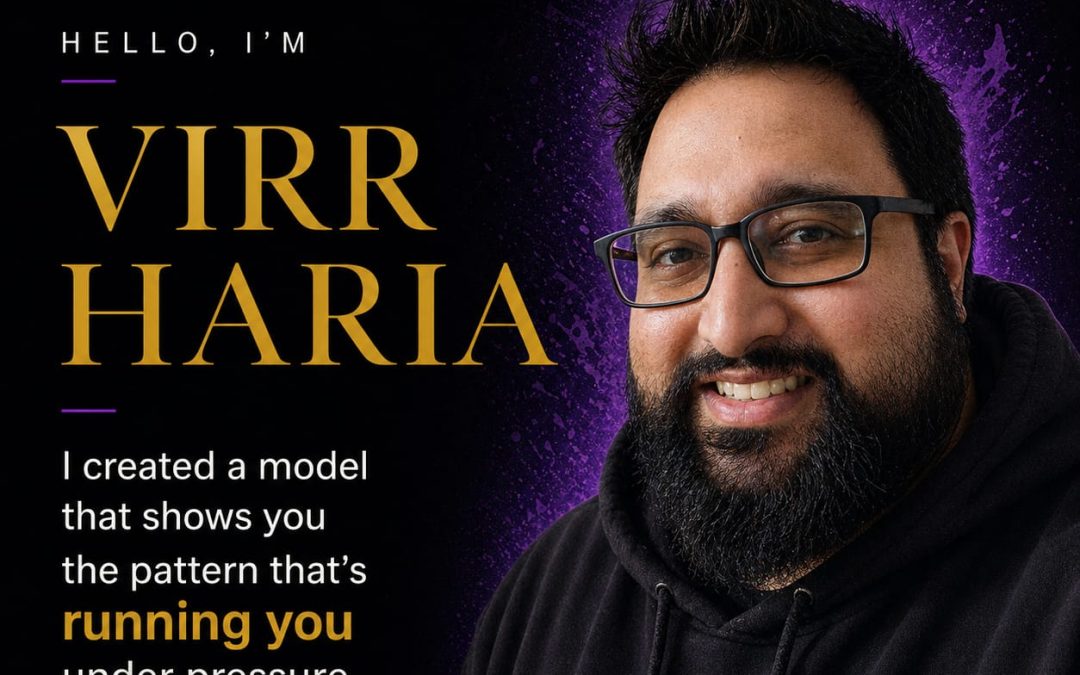
An introduction to Quantum Buddha, and why I built it
I want to start with a feeling rather than a framework.
The feeling of hitting the same wall. Different year, different context, different people around you, but somehow the same result. You push harder. You try a different angle. You do the work, the therapy, the workshops, the frameworks. And still, somewhere underneath all of it, the same thing keeps happening.
That was me for most of my twenties.
I grew up in a loud Indian household, the youngest of three brothers, in a family where love was real but rarely spoken out loud. I learned early how to read a room. How to manage the temperature of things. How to make myself useful, palatable, easy. I didn’t know I was learning anything. I just thought that’s who I was.
By my late twenties I had lived across London, Manchester, Southeast Asia, Australia, Vancouver, Edinburgh. I had done Tony Robbins events and CBT and private therapy and the Demartini method and men’s work weekends and plant medicine ceremonies. I had studied my Wealth Dynamics profile and discovered I was a Blaze, someone who leads through connection and energy and presence. I had read Jung. I had done the work.
And I kept hitting the same wall.
The controlling of situations before they could go wrong. The avoiding of conversations that mattered. The running to the next place when things got too real. The keeping everyone happy at the cost of myself. Not as conscious choices. As autopilot. As the thing that just happened when the pressure came on.
It took me a long time to name what was actually happening.
Under pressure, you don’t choose. You default.
Your nervous system, shaped by every difficult moment it has ever survived, runs a programme it learned a long time ago. Not because you’re broken. Because it worked once. It kept you safe. And the nervous system is extraordinarily loyal to what kept you safe, even long after the threat has passed, even when the very thing protecting you is now costing you everything you actually want.
Carl Jung wrote that until you make the unconscious conscious, it will direct your life and you will call it fate. I spent years thinking I was choosing. I was calling it personality. I was calling it circumstance. I was calling it bad luck or bad timing or just how things go.
It was a pattern.
There are four of them. Fight, the pattern that controls, pushes, defends, turns pressure into aggression or dominance. Flight, the pattern that avoids, hustles, distracts, escapes into busyness or the next horizon. Freeze, the pattern that shuts down, goes numb, stalls when it matters most. Fawn, the pattern that pleases, accommodates, loses itself in the needs of others.

Every one of them is a survival strategy. Every one of them was smart once. Every one of them is quietly running the show in ways most people never see, because most personal development work stays at the level of mindset and behaviour without ever getting to the nervous system underneath.
That’s the gap I kept falling into. I could observe myself in the pattern. I could watch myself doing the thing I knew wasn’t serving me, mid-action, with full awareness. And still not stop it. Because awareness isn’t the same as making something conscious. Knowing about a pattern and naming it precisely are two completely different things. One keeps you a spectator. The other changes your relationship to it entirely.
Unnamed, it owns you. Name it and you’re already ahead of it.
That’s why I built Quantum Buddha.
Not as a wellness brand. Not as another personality typing system. As a tool for the person who has already done a lot of work and is still hitting the wall. The person who is smart and self-aware and capable and still can’t figure out why the gap between where they are and where they want to be keeps staying the same size.
The Survival Pattern Test is where it starts. Four patterns, a short quiz, under three minutes. Not to label you or limit you but to give you a language for something that has been running you without a name. Because once you have the name, you have the beginning of a choice.
I am not a therapist. I am not a guru. I am someone who spent a decade doing every kind of inner work available, who kept hitting the same wall, who eventually had to build his own model because nothing else was getting to the root of it. And who, in doing that, found something that actually moved.
That’s what this is. That’s what I’m building.

If any of this sounds familiar, the wall, the work, the awareness that somehow isn’t enough, the test is free and it takes three minutes.