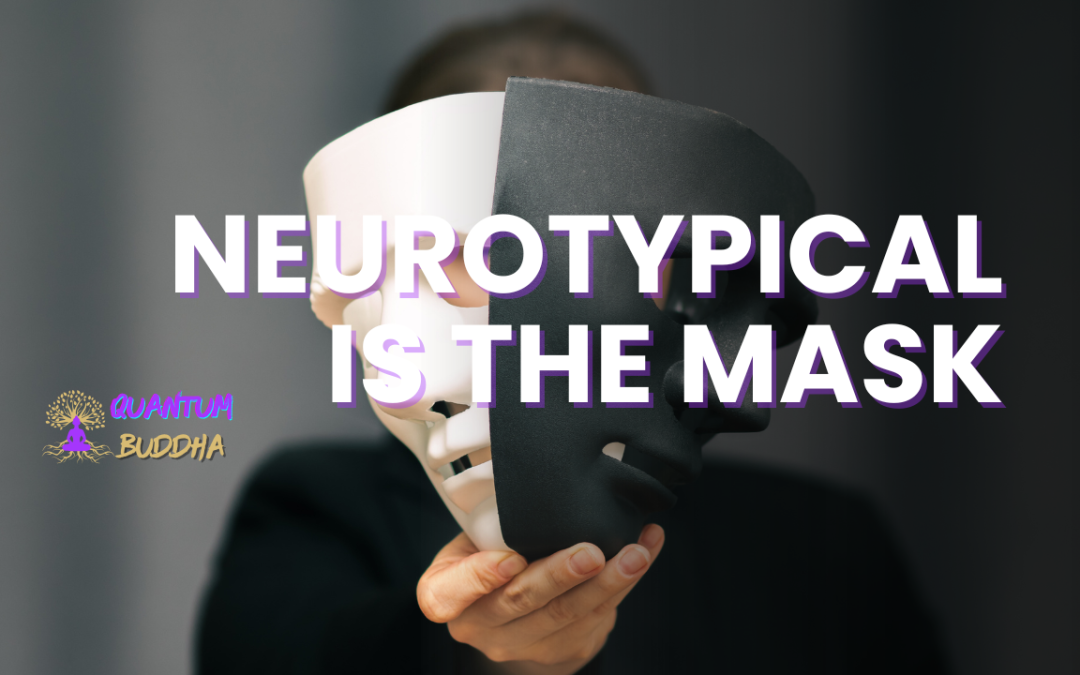
What if the “normal” ones are the most conditioned of all?
Table of Contents
- The Reframe That Stopped Me
- What Neurotypical Actually Means
- The Mask We Forgot We Were Wearing
- How Systems Create Standards
- The Biological Truth Underneath
- What Gets Buried
- The Real Spectrum
- What This Means for You
The Reframe That Stopped Me
I was ill in bed, scrolling, half-asleep, when a video stopped me cold.
The argument was simple: neurotypical isn’t the default. It’s the disease. Neurodivergent isn’t the exception. It’s the original.
I sat with that for a while. And then I thought: of course. That makes complete sense. Because what is neurotypical, really? It’s a standard. And standards don’t exist in nature. They’re created by systems that need people to behave in predictable ways.
This isn’t a post about ADHD or autism. It’s about something broader. It’s about the mask we were all handed at some point and told was a face.
What Neurotypical Actually Means
The word “neurotypical” was originally coined as a neutral descriptor, a way to refer to people whose neurological development follows the statistically common pattern. Fine. Clinical. Useful in context.
But somewhere along the way, it became a norm. And norms are not neutral. They carry an implicit message: this is how you’re supposed to be.
And here’s what’s strange. I cannot think of a single person I know who has ever felt fully at home in that standard. Not one. Everyone I’ve ever had a real conversation with, beneath the surface, has felt like they were somehow too much, or not enough, or slightly out of step with what was expected of them. Which raises an obvious question: if almost nobody actually fits the norm, who exactly is it describing?
Because the moment you have a “typical,” you also have a deviation. A problem. Something to be corrected, medicated, managed, or quietly shamed into conformity.
So who decided what typical looks like? It wasn’t neuroscientists working in a vacuum. It was built by the same world that needed people to sit still in classrooms for six hours, follow instructions without questioning them, perform productivity in ways that could be measured and rewarded, and suppress the parts of themselves that were inconvenient.
That’s not a neutral baseline. That’s a designed output.
The Mask We Forgot We Were Wearing
I’ve spent years building a framework around what I call Stress Masks. The core idea is this: at some point in childhood, you encountered an environment that couldn’t hold who you really were. Not bad parents, necessarily. Not a broken home, necessarily. Just a world with limited capacity for the full version of you.
So you learned to adapt. You developed a pattern. A way of showing up that kept you safe, kept you loved, kept you from being too much or too little. Fight. Flight. Freeze. Fawn. These aren’t character flaws. They’re survival strategies. They worked, once.
The problem is the mask becomes invisible. You wear it long enough and you forget it’s there. You start to think the mask is your face.
Neurotypical conditioning works the same way, just at a civilisational scale.
You learned to suppress the intensity of your curiosity because it disrupted the classroom. You learned to sit still because movement was a problem. You learned to process information in linear, sequential ways because that’s what could be tested. You learned to filter yourself before speaking because the unfiltered version got you in trouble.
And eventually, the filtering became automatic.
You stopped noticing you were doing it.
How Systems Create Standards
I had a conversation once, in the back of an Uber, ten minutes from home after a long trip back from London. The driver and I somehow ended up talking about hope.
He’d come to the UK from Brazil looking for something better. And after years here, he’d concluded there wasn’t much. Just a different version of the same thing.
Listening to him, something clicked for me. The governments he’d fled were threatening the bottom of Maslow’s hierarchy, safety, shelter, survival. People dying in the street. Visible, brutal, undeniable.
But the western version is subtler. Most of us live in relative physical safety now. So the attack moves up the pyramid. Job insecurity erodes the next layer. The loneliness epidemic and the collapse of community erode belonging. And then, at the very top, self-expression and self-actualisation, that’s where societal conditioning does its quietest and most complete work. We get taught to conform so early, and so thoroughly, that most people never realise they had a different version of themselves available. They don’t feel oppressed. They just feel vaguely incomplete.
Neurotypical as a norm operates at that top layer. Not through conspiracy. Through the quiet, accumulated weight of what gets rewarded and what gets pathologised and punished.
The child who can sit still gets gold stars. The child who can’t, gets a diagnosis.
The adult who conforms is manageable. The adult who questions too much is difficult.
The Biological Truth Underneath
Here’s what makes this more than just a social critique.
The Stress Masks I’ve built my whole framework around are not personality types. They’re not identity labels. They are biological survival mechanisms. They’ve existed for thousands of years because they worked. They kept your ancestors alive in environments that genuinely were threatening.
Fight: mobilise, confront, dominate the threat. Flight: escape, move, find safer ground. Freeze: go still, become invisible, wait it out. Fawn: appease, please, make yourself useful to whoever holds the power.
These are not flaws in your wiring. They are ancient software running on modern hardware in a world the software was never designed for.
And here’s the connection to neurotypical behaviour: a lot of what gets labelled as disorder is actually just a mismatch between an ancient nervous system and a modern environment that was built for compliance, not for humans.
The restless, distractible mind that can’t focus on the thing it’s supposed to focus on but can hyperfocus for eight hours on something it actually cares about? That’s not broken. That’s a hunter in a farming world.
The person who feels everything too intensely, who can’t just brush things off, who needs more time to process? That’s not too sensitive. That’s high resolution in a world that rewards low resolution.
The one who questions the rules, who can’t just accept “that’s how we do it here,” who keeps asking why? That’s not difficult. That’s someone whose nervous system is still functioning as designed, still scanning for what’s actually true rather than what’s been decided to be true.
What Gets Buried
I’ve done a lot of work in men’s circles over the past couple of years. King Warrior Magician Lover. Embodiment weekends. The kind of rooms where people really take the mask off, sometimes for the first time.
What I see consistently, underneath the performance and the armour and the years of getting it right, is aliveness. Curiosity. Sensitivity. Creativity. A capacity for connection that social conditioning had turned down so far it was almost inaudible.
And the grief that comes with realising how long they’d been turned down.
I had a plant medicine ceremony once where my whole family was present. And in that held space, something became possible that hadn’t been before. The full version of me had permission to show up. Not the adapted version. Not the one who learned to be manageable. The one who had been there all along, underneath everything.
What I wrote down that night was: “I am calling in Virr the Artist.”

Not Virr the entrepreneur. Not Virr the founder. Not Virr the responsible, productive, justifiable version. The Artist. The one who creates because it’s what he is, not because it can be monetised or measured.
That’s what gets buried. Not dysfunction. Aliveness.
The Real Spectrum
Here’s what I think is actually true.
Human beings are multidimensional. We contain multitudes. We are built for creativity, connection, curiosity, and depth. We are not built for fluorescent lighting and performance reviews and the particular flavour of slow suffocation that most people call Monday morning.
The “spectrum” that we attach to neurodivergence isn’t a spectrum of disorder. It’s a spectrum of how much of yourself you were able to preserve despite everything that tried to flatten it.
At one end: people who learned to compress themselves so completely into the acceptable shape that they genuinely can’t remember what they wanted before they learned what was expected. These are often the ones who look most “together.” The ones who function. The ones who are quietly falling apart at 2am because they’ve never let themselves be anything else.
At the other end: people whose nervous systems refused to fully comply. Who couldn’t make the mask fit. Who got labelled early and often and spent years being told there was something wrong with them for being what they were.
Both ends are experiencing the same wound. One just hides it better.
The neurotypical person isn’t the healthy one. They’re the one who adapted most completely. That’s not the same thing.
What This Means for You
I’m not saying throw out every structure. I’m not saying the nervous system that learned to be cautious or compliant is just a victim of society and has nothing to do with its own healing.
The Stress Mask you wear is real. The cost of it is real. The work of taking it off is real and it is not easy.
But the starting point matters enormously.
If you start from “I am broken and need to be fixed,” you’re beginning the journey from a place of self-rejection. You’re trying to heal yourself while agreeing with the wound.
If you start from “I adapted to survive in an environment that couldn’t hold all of me, and now I’m reclaiming what I adapted away from,” that’s a different journey entirely.
The mask is not your face.
The conditioned self is not your true self.
Neurotypical is not the destination. It’s a standard invented by a world that needed you smaller than you are.
And underneath it, still there, still waiting: the full version of you. The one that got quieted but never actually left.
That’s who this work is for.
If you want to find out which Stress Mask you’ve been wearing, and who’s underneath it, take the free quiz at quantumbuddha.co.uk. It takes three minutes. What you do with what it shows you is up to you.
Virr Haria is the founder of Quantum Buddha, a personal development framework built on the science of biological survival mechanisms and the possibility of who you become when the mask comes off. He writes about stress patterns, self-worth, and what it actually means to feel like yourself.